Sunrise was at 4.54 am. I rolled out of bed, pulled on some jeans and a short sleeved shirt. On impulse I pulled on my walking boots, grabbed my camera and headed out. I pulled into the carpark at Whitesheet a few minutes later, parked up and set off on a short walk to the heathland.
The light was still quite poor and there was considerable cloud cover. I had to set the ISO at 12,800 initially, to ensure a fast enough shutter speed to capture sharp images of moving wild life. After an hour all I had been able to photograph was a distant stonechat and linnet. The light was improving and I lowered my ISO to 6,400 without suffering a deterioration in shutter speed.
I was beginning to think that this was going to be one of those unproductive sessions. My wildlife photography can be like that. In those instances all you can do is write it off to experience. But then it occurred; a moment of serendipity when by being in the right place, the right moment came along. Nearly two hours after setting foot on the heath.
I was aware of movement in the bush next to me and a lot of twittering. I waited patiently. Finally after several minutes not one, but two Dartford Warblers appeared. They moved about constantly in and out of shot, but they didn’t fly off and weren’t spooked by my presence.
At 7.07am I pulled back into my driveway. The house was still quiet. I fed the dog and the cat, made myself a cup of coffee and a bowl of muesli and downloaded the shots from my old-fashioned DSLR to my laptop. These are a few of the pics:
Dartford WarblerDistinctive red eyelinerAlthough skittish, the dartford warbler held its pose just long enough“You can’t see me”“Now you can”
The temperature dropped this week. I went to scrape the ice off the car. I started the engine and noted that the external temperature was -6 degrees centigrade. It was sunny, but very cold. The car’s gearbox was frozen and at first, I was unable to put the car in gear. Eventually it thawed out sufficiently and I headed to Holt Heath, a local area of Dorset heathland managed by the National Trust, to take Pippin for his walk.
The sun was low in the clear blue sky casting long shadows. I was wearing four layers of clothing, good sturdy walking boots, a thick woollen hat pulled down over my ears, and thick gloves. I also had my camera with me. Despite the cold the birdlife was quite active, more active it appeared than previous weeks when the weather was more temperate. There were several Robins at the carpark and in the woodland. I could hear a couple of woodpeckers tapping tree trunks, and then I could see them chasing each other through the canopy. Unfortunately, try as I might, I couldn’t get a clean shot. The birds moved so quickly and the autofocus would get distracted by all the foliage and branches. From the colours I glimpsed, I think they were Greater spotted woodpeckers.
When we got out onto the heathland, I could see the unmistakeable outline of a buzzard perched in a denuded deciduous tree. The sun was to my right, at ‘about 3 o’clock’. It was about 200-300 yards away. I could just make out a slight head movement as I viewed it through my telephoto lens, scanning its surroundings. The footpath I was on passed the buzzard on the left, so as I progressed, the sun was increasingly angled behind bird. It didn’t appear disturbed either by Pippin running back and forth along the path, or by me as I pointed my camera lens at it. But then it got spooked and took to the air. It glided with the occasional flapping of its extended wings over the heathland toward the treeline on the horizon, and then it was gone.
Buzzard
We got to see Stonechats and Dartford Warblers. Both these species like to perch on top of gorse bushes and flit around. Sometimes they are visible taking a prominent position, then they drop to the ground out of sight before rising again. I have my camera to Aperture priority of between F8 and F10 when photographing wildlife. Then I push the ISO up to between 400 and 800 in good light like today. This results in a shutter speed high enough to freeze movement enough to get a sharp image. The only adjustment I make for each shot is the exposure compensation. For a bird against a bright sky, I push the exposure compensation up to between 1 or 2 stops, just enough to brighten the image without blowing the light background through the highlights.
Seeing Stonechats didn’t surprise me, but the Dartford Warblers were unexpected. I don’t normally see them at this time of year, even though they are resident all year round. My quest was not made any easier by Pippin’s presence. He is a young, energetic, skittish, Springer Spaniel. At one point I had lined up to take a shot of a Dartford Warbler sitting on a gorse bush. The light was perfect, and I was slowly stalking the bird to get as close as possible without spooking it. Just then a black and white bundle of energy charged past me crashing through the heath causing all wildlife, including my Dartford Warbler, to flee. I was livid as Pippin returned to me, tail wagging, tongue lolling out of what appeared to be a broadly smiling mouth.
Dartford Warbler – one I took earlier
I walked on a little further and met another photographer out with his dog, a black labrador. We chatted about the respective merits of each other’s cameras. He had a rather nice compact mirrorless camera with a telephoto lens of 18mm – 150mm. It was much easier to carry around than my bulky full frame DSLR with a 100mm – 400mm lens, but it didn’t have quite the reach for wildlife. I also think the battery life of the DSLR was better than the mirrorless. We were approaching mid-day and he felt that he had missed the best of the light. We exchanged information on possible photo ops on the way back to the car park and carried on, on our respective paths. It was interesting to meet another photographer and share different perspectives. Different equipment is interesting, but the conversation just made me feel again that it is photographers who take photos not cameras. The equipment simply records the photographer’s vision.
I will return to this location, without Pippin, but I’m not sure when. We are promised milder temperatures, but there is also a yellow weather warning (recently upgraded to amber) in place for the next couple of days as Storm Isha is on the way with winds of up to 80mph. The country is bracing itself for more floods and property damage. The ground is already water-logged and the prospect of more rain and high winds is quite concerning.
Added to the threat from Storm Isha I discovered a probable mains water leak this morning just outside my front drive. Fortunately, it is draining away from our property, but our front lawn is getting quite soggy. I have reported the leak to the water authority, and they have promised a response, but the timing isn’t great.
Winter Watch returned to our TV screens this past week. The BBC team were located at Arne on the south-west edge of Poole Harbour. It’s about 20 miles from home by road, but only about 12-13 miles as the crow flies. It’s good to see such mainstream interest in a local RSPB site, but it is probably a mixed blessing. I can imagine that visitor numbers to the site will increase because of the increased publicity. The road from Wareham to the Arne car park is 3-4 miles along a single-track road with occasional laybys for passing places. I didn’t see much of the coverage, but there was a piece on the successful reintroduction of the White-tailed eagle. It’s a huge bird, colloquially referred to as a flying barn door because of its size. A buzzard’s full wingspan is just one wing length of the White-tailed eagle. I haven’t seen one yet, but there has been a lot of excitement generated by its reintroduction in recent years.
Whilst visitor numbers will increase at Arne, it remains to be seen whether other local sites such as Holt Heath will also see an increased footfall. Holt has a mixture of woodland and heathland but is inland. It is primarily used by dog walkers, but there is some cattle grazing and horse riding. During spring and early summer, the heathland has nesting birds such as skylarks and so dog walkers are under instructions to keep their dogs on a lead and under close control during the months that nesting takes place.
I anticipate not being quite so active over the next few days as we batten down the hatches. I have enjoyed getting out this last week. The colder weather brought its challenges, but the brighter crisper weather did improve the light quality for photography and brought out the birdlife more than the recent wet weather. Hopefully, Storm Isha will pass quickly. I will be giving time to some of my indoor projects.
The archiving of old family photos is progressing well. I found an old studio photo of me from 1962 or 1963, which I am now using as my Facebook profile picture. I should be able to make quite a bit of progress whilst Storm Isha rages outside.
I will also give a bit of time to improving the look of the Tuba I am playing in the brass band. It is a silver instrument, and the silver is tarnished in places. I’ve used a mixture of bicarbonate of soda and water to get rid of some of the tarnishing. I also gave it a bath to clean it up. There are a couple of dents which it would be nice to get sorted, but they don’t affect the sound. I’ve ordered some silver cream, which is recommended by the manufacturer to restore the silver to its original condition.
I hope your week is going well. I took a break today from preparing Monday’s longer blog post and headed down to Durdle Door with Edd. We parked at Lulworth Cove and walked the 1 mile along the Coast Path to Durdle Door. We arrived at midday and the sun was peeping from behind grey cloud cover.
Man-o-war Bay – long exposure
Man-o-war Bay is just to the east of Durdle Door in the direction of Lulworth Cove. The bay is named after the shape of thr rocks in the cove which are said to resemble warships of the 16th to 19th Centuries, known as Man-o-war.
Rock Pipit
As we were packing up I saw this rock pipit hopping along the path and I couldn’t resist switching lenses to my telephoto.
I hope the remainder of your week goes well and I’ll get back to finalising Monday’s longer blog post.
The autumn sun is shining through the window. A slight breeze is causing some of the uppermost branches of a nearby tree to sway. It’s 3 o’clock in the afternoon and the house is empty other than for Pippin, our spaniel, and me. Pippin is curled up on the sofa next to me with one eye on the driveway longing for Jacki’s return.
I usually write in the morning, first thing before anyone else is up. Sometimes I am joined by one of our boys if they wake early, but most times I get to jot down a few thoughts. My routine is to record my feelings and reflections followed by three things I am particularly grateful for. Finally, I read a passage from the Psalms. I have been using Tim Keller’s book ‘My Rock, My Refuge’, a daily devotional that takes the reader through the Psalms in one year. I am on my second year.
I am challenging myself to write a bit more. I have a blog which I post photos of wildlife, and I would like to extend the length of the text. From recent research I can see that there has been a change of opinion over recent years about the minimum word count for a blog. 10 years ago the advice was that 500 words was an acceptable minimum. Now this has been extended to 1,500 – 2,000 words. Whilst acknowledging that most readers will only skim read, the suggestion is that a word count of 500 hundred only permits a writer to scratch the surface of the subject they are writing about. The extended minimum allows the writer to go into a bit more depth. It requires a bit of research and a little more thought and preparation.
I recently used my blog to record my training for running a half marathon, my first in about 7 years. I set myself a challenge of getting ready for the race in just 8 weeks. There were several motivating factors. The first and primary motivation was my wife’s recovery from breast cancer and heart failure. I wanted to use the run to express my gratitude to God for answering my prayers and the prayers of family and friends. I set up a JustGiving page which provided supporters a way to offer their support to others who face a similar set of circumstances.
The blog worked well and required more text than normal but fell short of the recommended minimum. I continued to use photographs, as they help to illustrate ideas and offer a visual impact. I was particularly pleased to exceed my fundraising target. I think giving friends and family regular training updates helped me to take them with me as I prepared myself for race day. It certainly helped me maintain my focus and motivation.
I have been running my blog for a few years now and it seems appropriate to stand back and reflect on what it is that I am hoping to achieve with it. The post that received the most views and was by far and away the one that seemed to capture substantial interest was a post from 2019. I had taken my boys on an afternoon visit to a local reservoir, Longham Lakes. I had given them both a camera to record what they saw. To my amazement virtually the first bird we saw was a yellow and black bird, about the size of a finch sitting on top of the reedbed. It turned out to be a Yellow Crowned Bishop. It was a long way from its sub-Saharan home. Apparently, they migrate north and are summer visitors to Portugal, still a long way from a reservoir in East Dorset. At the time I posted it, it aroused a little interest, but in July and August 2021 was viewed 239 and 445 times respectively. This may not seem high but compared to the normal monthly viewings of under 5 it was a massive jump.
Looking back at the statistics most of this traffic came from Facebook, but not from my Facebook page. Someone with a large following must have discovered my blog and posted a link which their followers then followed. It would be interesting to bird watchers – evidence of a migrating bird discovered outside its usual habitat. Twitchers love that sort of thing.
Whilst it is rewarding to see increased interest, that has not been my primary goal. Initially I was looking for feedback on my photography, as I was new to digital photography. My skill set was quite rudimentary. I had a digital camera with a telescopic lens. For the first few months the settings were on auto, and I only had the camera set to capture JPEG formats, not RAW. Gradually my knowledge and experience allowed me to use some of the manual settings and both my shooting and processing improved. I switched to capturing RAW files, which gave me greater control over the processing of the images. I also discovered post-production software and was able to manipulate the resulting images with an increasing array of tools.
I was aware of the triangulation of settings within the camera of ISO, shutter speed and aperture. My preferred setting initially was to fix the shutter speed and ISO and let the aperture vary automatically. Later I switched this to aperture priority, which gave me greater control over image quality.
When taking a shot now I will adjust the ISO based on the prevailing light conditions, I then adjust the exposure compensation for each photo. If there is a light background with a dark subject, I increase the exposure; if the background is dark and the subject is light, I decrease the exposure.
Photographers will tell you that it’s not the camera that takes the photo, but the person behind the lens. To a certain extent I agree. It would be very expensive to keep up with the latest technology. The person taking the photographs has a vision that precedes the photograph. When I take a photo, I have an idea of what I am trying to achieve. But there comes a point at which the equipment holds you back. That has been my experience. There have been key moments over the last five years when I have made step changes in image quality with carefully chosen equipment upgrades. I now use a full frame sensor instead of a crop sensor. I have a higher specification telescopic lens for wildlife and a wide-angle lens for landscapes. I also have a “nifty fifty” for street photography.
But technology is several steps ahead of me. I haven’t yet upgraded to a Mirrorless camera, but there may come a time when I need to do this. This will be when I feel constrained by my current kit and currently this is not the case.
I think for the next phase of the blog I will continue to use photographs, but maybe fewer – just one or two per post. And I will put more effort into the text and see where we go. This is pretty much the approach I took with photography – I just wanted to improve the image quality and learn how to take wildlife photos. I want to improve my written communication of ideas and themes. These will probably be related to wildlife and photography, but other interests may creep in. I would like to develop a two-way communication with readers through the comments section, so I invite you to add your comments and feedback.
I will try and be a bit more disciplined in updating the blog and establish a regular weekly posting routine to help readers engage. Hopefully, there will be something of interest and thought-provoking.
I have restricted myself to a single image for this post: a rainbow representing promise (remember God’s covenant with Noah and all mankind – as recounted in Genesis chapter 9). It was taken locally this past weekend. There was a break in the rain and so we headed out with Pippin to stretch his legs. It’s one of our favourite places to walk where I have taken photos of various bird species including stonechats, Dartford warblers and nesting skylarks. On this occasion it was the rainbow that caught my eye – so bright against a dark sky. I could see clearly where it touched the ground but there was no pot of gold. It was a double rainbow. You can just make out the second to the right of the main one but its very faint. So, there I will leave things for the moment – promise and hope. A promise to produce posts regularly and hope that you will find it engaging.
Old Harry bathed in sunlight from Durlston Castle, with Bournemouth pier and seafront in backgroundLooking west to Dancing LedgeLooking east
In August 2023 I walked the 8 miles from Corfe Castle to Swanage. It was a wake up call as I struggled up the climb to the Obelisk.
The climb to the Obelisk (just visible) – the location of my August struggle
It was halfway up the 220 steps that I was brought face to face with my lack of fitness. In the intervening 8 weeks I have trained for, and last week ran in, the Bournemouth half marathon.
This week I returned to the Isle of Purbeck. Temperatures were more autumnal and it was mainly sunny, only breaking into a rain shower after we had sat down on the grass to eat our sandwiches. The rain was refreshing and quickly passed.
Our route was an 8 mile circular walk starting and finishing at Durlston Castle, just outside Swanage. We followed the South West Coast Path to just beyond Dancing Ledge, where we headed inland to join the Priest’s Way footpath and looped back to Durlston Castle with stunning views of the Isle of Wight and Poole Harbour. The following photos are some of the wildlife along the way. We were at the wrong time of year to see Puffins, but there are recorded sightings of a small number in May at Dancing Ledge. Note to self to return next spring.
Peregrine falconWren (pretending to be a Stonechat)Female StonechatMale Pheasant breaking coverRed AdmiralDeer
I am tired. My legs feel like lead. The training is taking a toll on my body. I did a long run yesterday evening: 9 1/2 miles. My mind is also filled with doubts. I will be competing with much younger runners. Those in my own age bracket (I was 65 last birthday) will be serious runners. The years will have weeded out other runners like me. My PB for the half marathon was set in 2010. My last half marathon was seven years ago and was significantly slower. What makes me think I can do this?
Well, its not all about me. Macmillan Cancer Support have contacted me this week. They are sending me one of their green running vests for the race. They have been encouraging. Their fundraising target for Bournemouth is £117,000 which will be used to fund 3,500 hours of specialised Macmillan nursing care; provide 4,600 people living with cancer a session of emotional support with a Macmillan buddy; run the Macmillan Support Line phone service for 10 days, dealing with approximately 2000 calls and web enquiries from people who need their support.
My own fundraising target is far more modest, but combined with others will make a significant impact on people at a very vulnerable stage of their lives.
Finally, I haven’t lost sight of the fact that this is a wildlife blog. On a walk this week I spotted a buzzard perched at the top of a leafless tree. I took a few shots from a reasonable distance before he/she launched into a leisurely paced flight.
I love to visit Badbury Rings. Today was a chill 4 degrees. The sky was cloudless. The sun was low even though it was close to noon, casting long shadows. The kestrel landed in a tree, but I was on the wrong side. The bird was silhouetted against the sun. I carefully changed position, hoping not to spook it. It was a male bird, slightly smaller than the female, but slightly more colourful. I was rewarded with a series of photos with the sun illuminating the glorious colours: chestnut brown, grey, black and yellow.
Suddenly, the kestrel launched itself out of the tree into the open sky.
The low sun lit up the side of the kestrel including parts of the outstreched underparts of the wings. Its ferocious yellow talons were clearly visible. It swept slowly over the farmland, stopping periodicaly to hover over a particular patch.
Earlier this year I bought myself a New Testament in the original Koine Greek language. I was surprised by the order of the books. In my English Bible Paul’s letters follow on from the Gospels and Acts. In the Greek, the catholic or general epistles precede Paul’s. Thus the first letter is James’.
What is the first thing that James says to his readers? “Consider it pure joy, my brothers and sisters, whenever you face trials of many kinds, because you know that the testing of your faith produces perserverance. Let perseverance finish its work so that you may be mature and complete, not lacking in anything.”
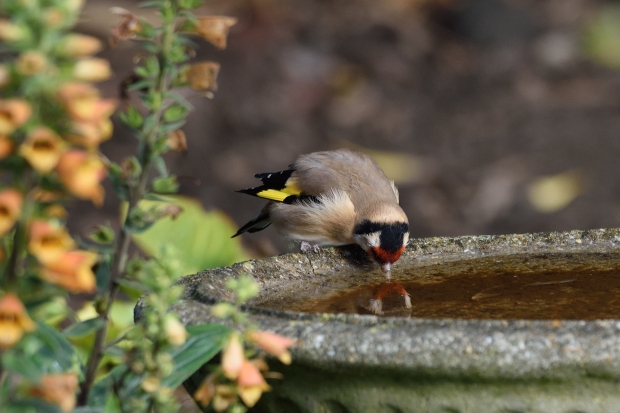
I have a bird bath in my garden and have been waiting for weeks to capture a photo of a bird actually using it. This week the waiting finally paid off. First a goldfinch came a drank right in front of me, then, the following day, a green finch did the same thing. On both occassions I was only a few feet away with my camera in hand. My patience and perserverance finally was rewarded with some great close-up shots.
Please excuse my mundane and simple anecdote, to illustrate such profound, biblical and pastoral teaching. I was thrilled to get these photos. I wonder whether James had this feeling in mind when he urged his readers to ‘consider it pure joy’.
We arrived at Old Henley Farm at 6.30 pm. About 30 miles from home and halfway between Dorchester 10 miles to the south and Sherborne to the north. We parked and unpacked our gear ready for a short trek over farm land. Our destination was a hide that we had booked for the evening. It overlooked a secluded area of grassland next to a wood and we were promised sightings of a badger family. We were not disappointed.
A young Badger
A single young badger was the first to appear. He shuffled around the grassland in front of the hide, but got spooked when someone dropped something inside the hide. We thought that maybe it, but later four badgers gingerly reappeared, attracted by the food. The natural light was all but gone and we were reliant on the floodlights that the badgers were quite used to.
The family of four badgers reappearDespite low light and slow shutter speeds we were rewarded with reasonably sharp images




 Stephen's Wildlife