November 2020. The weather is overcast, with an occasional ray of sunshine peeping through the cloud cover. The wind is blowing with the sea looking decidedly choppy. Several cruise ships are just visible at anchor in the bay off Hengistbury Head. The car park is full. People taking exercise and walking dogs. And then I see her. Absolutely unmistakable hanging in the air no more than 15-20 feet above the grassy bank next to the car park. Fearing that she will be spooked by my presence I walk slowly toward her. She is completely unphased. Her head remains quite still as her wings and tail flutter just enough to keep her motionless in the wind. Her focus is solely on the ground beneath her. She permits herself a momentary glance in my direction, before resuming her search.
Male Kestrel
I absolutely love this photo taken by my son on a visit to Badbury Rings in August 2020. The chestnut brown wings with black tips, the grey head and that beak and black eyes circled in yellow are all so clear. It is the grey head and slightly smaller size that distinguish the male bird from the female. The bird is at rest and is aware of our presence, but allows us time to get this photo.
Male Kestrel on the hunt
Another of my favourite sites is Stanpit Marsh on the other side of Christchurch Harbour from Hengistbury Head. On a visit in October 2020 this male kestrel was the star turn. He was on the hunt and very nearly caught this stonechat, but not quite.
The winter of 1962/63 is within my living memory. I was four and living in the Midlands. I remember the woolen mittens (attached to each other by a long string of material up one sleeve, across the back of the shoulders and then down the other sleeve); a bobble hat and scarf that went round my neck several times making it almost impossible to move my head independently. My whole body would have to move to enable me to look at whatever caught my attention. I remember the snow, making snowmen, snowball fights and the subtle change that a carpet of snow made to sound.
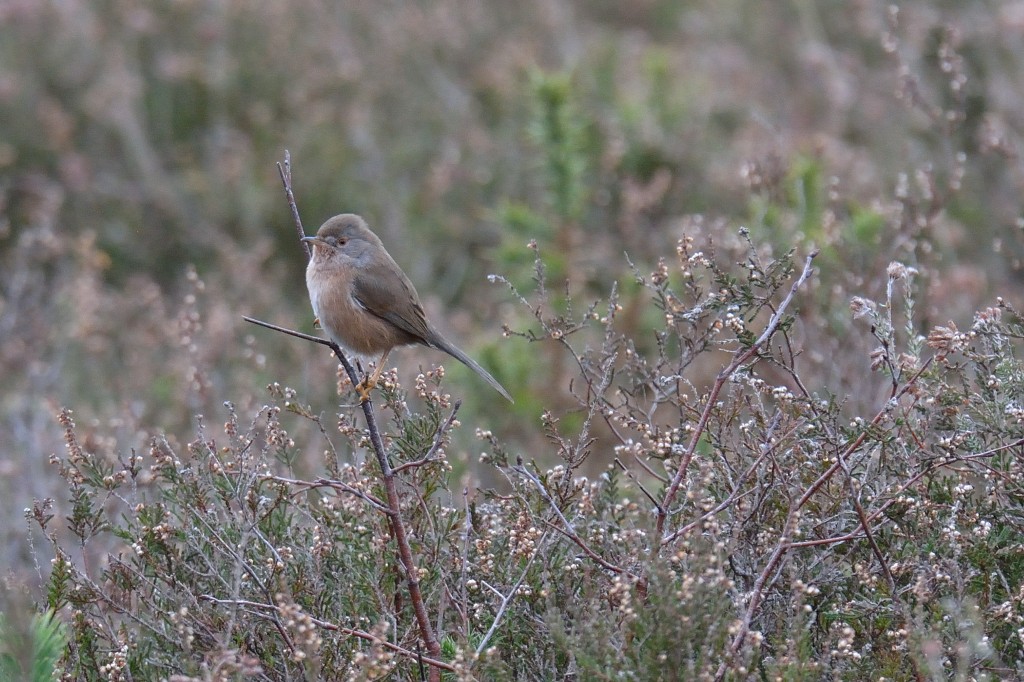
The Dartford Warbler did not fare well during that winter. Only 10 pairs survived in Britain (source: RSPB Handbook of British Birds, page 240). From that low point the population has gradually increased to over 3,000 territories. It is primarily found in counties along the south coast of England. It lives on dry lowland heath and commons where there is gorse and heather.
This bird has been on my wish list for a long time and I have made a number of unsuccessful visits to places like RSPB Arne. This week November 2020, finally I made my first sighting at a location just 3 miles from home, whilst walking the dog.
Digiscoping is a new word credited to French birdwatcher, Alain Fosse, in 1999. It refers to the technique of attaching a spotting scope to a digital camera for the purpose of taking close-up photos of birds and other wildlife from a distance. Two other pieces of essential equipment are: an adapter to attach the camera to the scope, and a tripod to hold the combined camera/scope.
There have been subsequent technological improvements in cameras and lenses, giving the amateur wildlife photographer the ability to capture stunning close-up images with light weight, hand-held cameras. However, for the past few months I have been experimenting with digiscoping with mixed results. Early results were disappointing: poor focussing, lack of sharpness, and dull images.
I reached a turning point in January during a morning visit to Stanpit Marsh, on the eastern shores of Christchurch Harbour. There was bright sunshine, low in the sky. I set the magnification of the scope at a mid-point. On maximum magnification not enough light is let into the camera, and on the minimum setting the image is distorted around the edges. My subject was a Little Egret, a large white bird, which stood out very clearly from its background. It wasn’t troubled by my presence and in any case, I didn’t need to get too close.
Little Egret
Spurred on by this success I returned a few days later in similar conditions, but this time it was colder and there was a frost covering on the grass. My attention was drawn to a small dark coloured bird flitting around a gorse bush, a male stonechat. It stood out from the white frosted background. This bird was more challenging than the Egret. It was constantly moving and was a lot smaller.
The activity requires a lot of concentration to track the bird as it moves and to keep it in focus. There may have been some frustrated muttering under my breath. I had chosen to set myself up just next to the main footpath. There were only a few people around, due to the cold. One passer-by was walking her dog and, curious at my concentrated activity, she engaged me in conversation. I felt torn between maintaining my focus on the stonechat and not ignoring a polite request to chat. I chose to chat. After a few minutes I was able to resume my photographic efforts, feeling slightly more relaxed. Fortunately, the stonechat was still around.
Stonechat
I moved on to other subjects: a redshank and a curlew. In my opinion these were less successful due to the contrast between the subject and the background.
In subsequent months I have used the technique to capture close images of the Great Spotted Woodpecker and the humble, ever present Robin. I have yet to perfect the tracking of a bird in flight. I recently tracked a Buzzard but struggled to keep the bird in shot as well as manually adjust the focus on the scope.
Robin and Great Spotted Woodpecker
Digiscoping requires the right conditions: strong light and a strong contrast between subject and background. It requires patience and persistence to perfect the technique. Advances in technology may ultimately render the technique obsolete, but not yet.
We opened the door of the hide at Holton Lee and and several heads turned to greet my son and me with the news that a sparrowhawk had visited the feeders about 17 times. Each time it swooped in, circled the area, remaining in flight only to retreat to nearby trees. No sooner had we settled than the bird flew in but this time landed.
It stayed put for only a few seconds, but just long enough for us to capture a few snaps. My son had his camera well set up with a fairly high ISO and shutter speed of 1/1,000 sec and captured a handful of sharp shots.
The consensus view was that the bird must be young and inexperienced – and hungry.
Three O’clock on a cloudy, dull Sunday afternoon my 9 year old son and I headed out. With two hours of daylight left we drove the 11 miles to the Blashford Lakes Nature Reserve, just north of the Hampshire town of Ringwood. The car park was full; people wanting to make the most of the weekend before starting a new week in the morning. We fully intended to head to their woodland hide, as you are almost guaranteed a range of small woodland birds. There was a volunteer warden at the entrance and we stopped to chat. A number of visitors reported seeing a kingfisher at the Ivy South hide, so we headed there instead.
No sooner had we walked in and settled ourselves than this beautiful male kingfisher landed in front of the hide. It wasn’t in any hurry. It jumped up to fly and we thought that was it, but no it landed again, this time even closer. Between us we must have got about 20-30 pictures. The one pictured above was taken by my son and is our favourite image.
This black, white and orange bird is quite striking in appearance. I went out earlier this week in freezing temperatures There was a bright, low sun shining in a cloudless sky. This small bird just sat himself in front of my camera. I love the bright colour and the contrast with the white, frozen grass. For comparison I include a photo I took in mid summer. The winter colours are a little more muted. There are about 56,000 pairs in the UK, mainly around the southern and western coasts
Wildlife photo opportunities last only a few seconds. This female sparrowhawk landed in my back garden this morning. This was the first time observed visit in the last fifteen years. It stayed for only 20-30 seconds, then it was gone. The poor quality of the photo reflects: the low light conditions (requiring a high ISO setting and a low shutter speed), shooting through a dirty patio window, and the limited time available to adjust the manual focus.
There are over 35,000 pairs in the UK. It is an extremely swift bird of prey, taking its quarry by surprise. It will attack most bird species up to the size of a wood pigeon.
On Sunday afternoon we had bright sunshine and being January the sun was low in the sky. It was very cold, so I wrapped up warm and headed down to a local salt water marsh, Stanpit Marsh. Two bird species caught my eye: a little egret and the redshank.
The redshank gets its name from its long red legs. The bird also has a long bill, which starts as orange-red near the base becoming quite dark at the tip. It is just under 30cm amd has a dark brown back and a lighter coloured chest and underparts.
There were numerous birds spread out over a large area of the marsh, all with heads down busily scouring the ground for food.
There are said to be 160,000 redshank in the UK, but the population is thought to be in decline.
At this time of year the UK population of oystercatchers swells from 100,000 pairs of resident birds to over 400,000 individuals. The migrants come from Norway, Estonia and Russia. Although primarily found at coastal sites, particularly estuaries, they have increasingly colonised inland sites.
Oystercatchers landing
Outside the breeding season, the birds gather in flocks. They are large black and white waders with red beaks and legs.
The sun shone today and the rain stopped. Yellow leaves underfoot clearly indicated the season.
Chaffinch
The cafe courtyard was occupied solely by a chaffinch. All human patrons headed indoors and shunned the al fresco dining at the external tables and chairs
Wren
We could hear the wren from the path, but could not see it. Following the sound and heading into the undergrowth it suddenly showed itself, before disappearing deeper into the foliage.
Robin
Not so timid, the robin. Bold and brazen he perched in front of the camera as if asking which profile I preferred.




 Stephen's Wildlife