

The Mute Swan is one of the UK’s largest birds (125 – 155 cm). It is specifically protected in laws dating back to 1387.
In flight it has long, slow, strong wingbeats.
Passionate about wildlife
The Mute Swan is one of the UK’s largest birds (125 – 155 cm). It is specifically protected in laws dating back to 1387.


In flight it has long, slow, strong wingbeats.

The Common Buzzard is a large bird of prey (51 – 57 cm). It is the UK’s most numerous bird of prey (79,000 pairs)

As well as its habit of soaring and gliding, it can also be peen perched in trees or on posts.


Other large bird, such as rooks or crows, will harass Buzzards and chase them from their territory.

The wren is more likely to be heard rather than seen. Its latin name of ‘Troglodytes Troglodytes’ means cave dweller. It is astonishingly loud for such a small bird (10 cm).


Despite a population of 8.6m in the UK they are very shy and generally keeps low and as inconspicuous as possible.

Cormorants are about the size of a large goose (80-100 cm). They feed on fish and are equally at home in the water and in the air.


Cormorant colonies are increasingly found inland. They can be seen perching on power lines and pylons, as well as on purpose built perches on inland lakes and reservoirs.


Take off from the water surface can be a ‘splashy’ affair, as the bird struggles to get airborne. Its flight over water continues at only a few feet above the surface before eventually gaining height.


The Common Kestrel is the UK’s second most populous bird of prey, behind the Common Buzzard. There are 46,000 in the UK. They are usually seen practising their party piece – hovering over rough grassland in search of small mammals or birds.


The Kestrel is a small bird of prey (32-35cm), but not quite as small as its cousin, the American Kestrel.


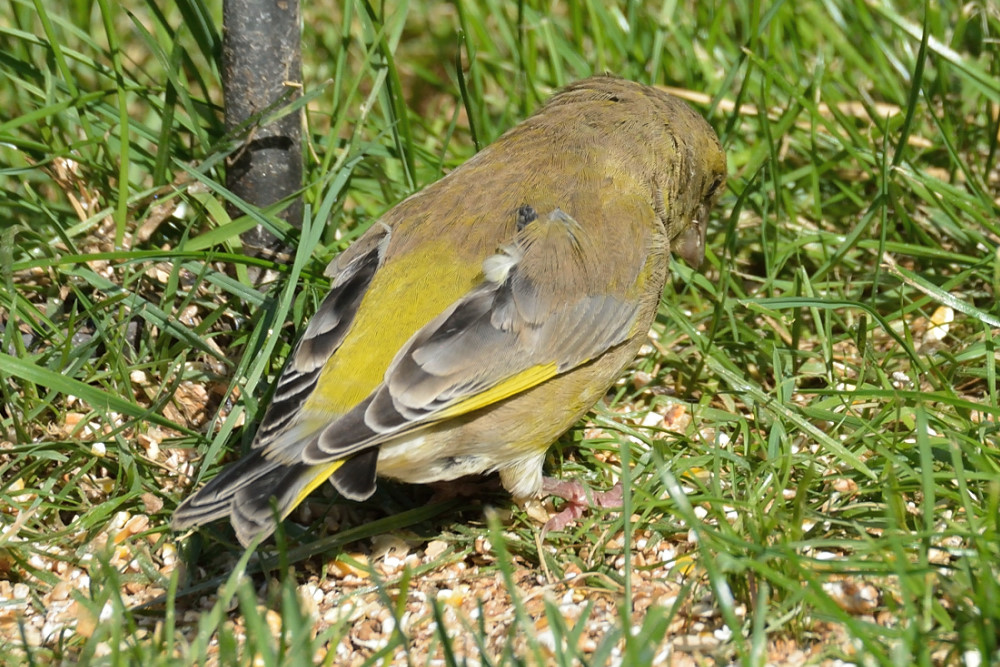
This male greenfinch is a bright yellowish green, while the female is rather duller. Look out for them in woodlands, hedgerows, parks and gardens.

It is a small bird, about the same size as a house sparrow. (14 cm) There are about 1.7 million pairs in the UK.
Rare visitors this month include peregrines overhead as well as willow warblers hiding deep in the foliage. Dragonflies, bees and butterflies maintain their seasonal visit. September has also seen the ongoing presence of resident birds such as sparrows, robins and blue-tits.


Colour continues into September. The purple Clematis particularly provided a beautiful backdrop. The roses revival is nothing short of resurrection, considering the dry, brown state of the whole bush in August. A trip to the local garden centre injected some additional colour. No idea what we got – the sole criteria was that anything we bought had to be in flower.


The dragonflies continued presence was as welcome as the warm, late summer temperatures. My photography skills limit my ability to catch these bugs in flight. I have to wait until they land before approaching with the camera.


There are long stretches of time when there are very few birds present in the garden. Sparrows arrive one or two at a time, but these gregarious birds are not on their own for long.


Our sparrow population has risen this year. There is now a group of about a dozen birds. When they are in the garden they chat to each other as they move around. However, they can be very quiet once settled.


We are used to seeing Common Buzzards circling overhead. This Peregrine Falcon was a pleasant surprise and represents a first sighting from the garden. It was instantly recognisable, as we had seen some close up at Bird of Prey centres earlier in the summer.


The long-tailed tits are similar to sparrows; they come in groups. After a summer break they are returning to the garden.


Greenfinches are difficult to spot. They blend in so well to the background; its only when they move that one’s eye is drawn to them. Goldfinches are regular visitors, but tend to stay high in the trees. Some of the juveniles are tempted down onto the feeders occasionally.


A first sighting of a willow warbler in the garden.

I have restricted myself to only five images from the garden in August. These are in no particular order, and have been chosen to illustrate the simple, diverse beauty of wildlife on my own door step for which I am grateful.

The Speckled Wood Butterfly stood out for me, because of its more muted appearance compared to the more colourful red admiral, peacock and painted lady.

The dragonfly is a fascinating creature with detailed inspection made possible to anyone with a mobile phone. This one sat in the sun, allowing me to get close whilst it soaked up the warmth.

These cute little fluff-balls returned to the garden in August after an absence of a few weeks. These three descended on the peanut feeder, which was a little unusual; they normally head for the mealworms.

After a month or two of the parent blue-tits looking a bit dishevelled as they moult and the juveniles appearing in muted grey and pastel yellow, it is good to see the beautiful, fresh blue and yellow of the mature bird.

These juvenile sparrows are the product of the amorous parents pictured in previous month’s blogs. We have a healthy, growing population despite the attention of local cats, including our own, or the odd, infrequent sparrowhawk strike.
Temperatures have exceeded 30 degrees Celsius. Not since 1976 has Dorset been this hot. There have been great opportunities to photograph widely differing species, some like the dragon flies and butterflies quite exquisitely beautiful. The sparrow population in particular has increased significantly since spring.
The garden has well and truly come alive with all sorts of creepy crawlies: peacock butterfly, red admiral, greenbottle flies, hoverflies, dragonflies, bumble-bees, honey bees.


Record temperatures have encouraged buzzards to soar on thermals in search of prey. As they pass over the garden, smaller birds call out warnings to each other, as they scurry around seeking cover.


Jays, blue tits, robins, goldfinch and sparrow are among the juvenile species seen this month.


At least two clutches of juvenile sparrows have produced so far. Judging by the antics of these two, there are more to come.


 Stephen's Wildlife