The Great White Egret is much larger than the little egret. It has a yellow bill in the winter, which turns darker in the breeding season. In 2006 there were only 300 in the UK. Numbers are increasing.
Great White Egret in flight
Heron-like in flight, it also has similar feeding diet and behaviour, waiting beside water and striking at passing fish.
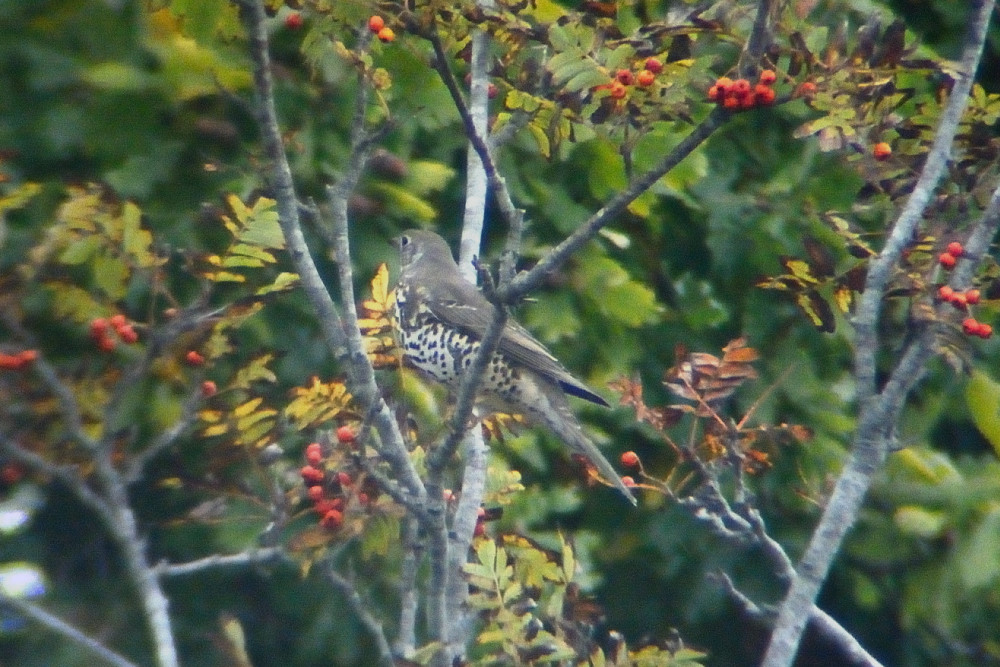
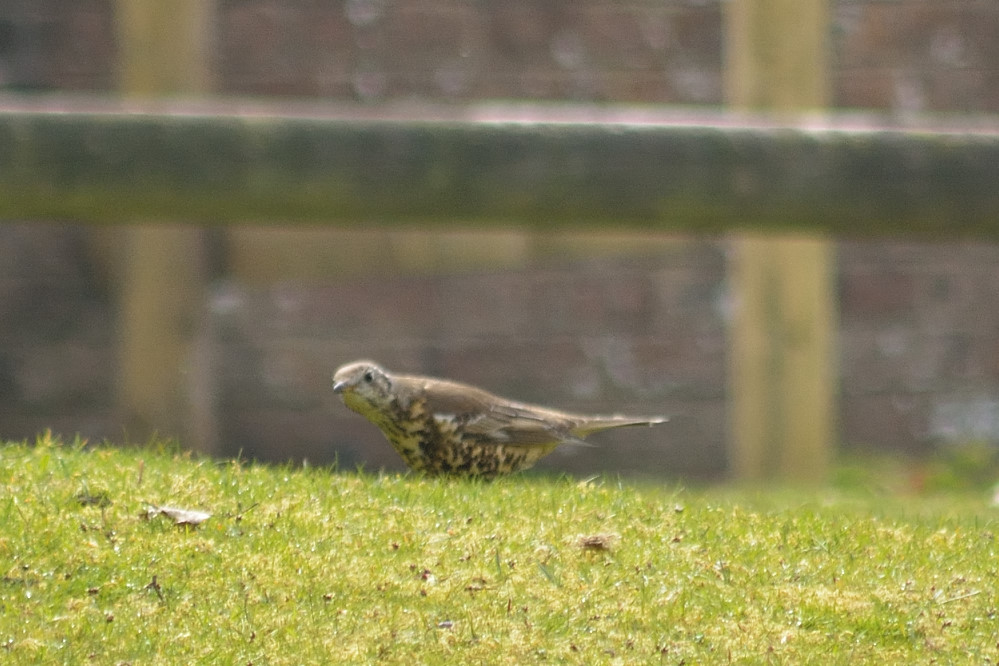
When I lived in London I used to see Thrushes regularly on my jogs around Victoria Park in Tower Hamlets. That was 15 – 20 years ago. Today (23/10/2019) I saw one from my Dorset garden for the first time in quite a while. There are 170,000 Mistle Thrush pairs in the UK, a decline of 40% from 1969. They moult from May to September, so looks quite smart in October in its new feathers.
Song Thrush
The Song Thrush (23 cm) is smaller than the Mistle Thrush (27 cm) and more common (1.2 million). It is seen quite often on the ground searching for juicy worms, but also feeds on caterpillars, beetles and berries in the autumn.
There are about 1 million territories of Carrion Crow in the UK. It’s considered a pest and farmers use a number of techniques to keep these birds away, e.g. scarecrows. A group of crows is known as ‘murder’ of crows, slightly more menacing than a ‘charm’ of finches or ‘parliament’ of owls.
Crow taking flight
The crow is slightly less gregarious than the rook, although they may form groups in roosts during the winter
Hengistbury Head is a headland just south of Christchurch. It is east of Bournemouth and north west from the Isle of Wight. I’ve been visiting this Ancient Monument and Nature Reserve since the 1970s, although its probably 18 months since my last visit. The weather was bright and sunny on Saturday afternoon (19/10/2019) as we pulled into the visitors car park. There were plenty of people and cars around, but not quite as packed as it can be during the peak summer months.
Stonechat
We walked across the open heathland to the pebble beach overlooking Bournemouth Bay and from there took the footpath up over the head to Mudeford. This path took us past fenced off areas of grass and gorse. We spotted a stonechat sitting on the fence and took the photo above.
Toadstool – Amanita muscari
As we descended from the headland to Mudeford we walked through some overgrown woodland and came across this iconic red toadstool. At Mudeford we turned back along the beach.
Isle of Wight (needles) from Hengistbury Head
The sea state was choppy with white horses and the wind was probably force 4 or 5. Looking south east we could see the Isle of Wight. I have been here when visibility was quite poor, but today was very clear.
Meadow Pipit.
On the bank leading up the steep slope/cliff behind the beach we spotted a meadow pipit hopping around looking for insects.
Turnstone
A little further on as we walked back along the beach we saw this bird. We didn’t recognise it at first, but later identified it as a Turnstone.
Kite surfer
As we looped back along the beach we saw a few folk enjoying water sports. A heavy, grey cloud blew in from the west bringing a short shower.
Back at the car we loaded two saturated boys and a sopping spring spaniel. They had all become a little over excited at the sight of the surf and got a bit closer than was intended. A fun afternoon!
There are 3.6 million pairs of blue tit in the UK. As well as the black ‘mask of zorro’, it has blue cap, wings and tail. The back is green and the underparts yellow. It is a regular visitor to gardens, but is also seen in woodlands and parks.
Blue tit in flight with peanut
This photo was taken this afternoon (21/10/2019). The shutter speed was 1/2000 sec, which indicates just how fast those wings move. Despite the imperfections in the photo, I was pleased to capture a dynamic image.
Found on low land reservoirs and lakes in the UK, there are about 5,300 Great Crested Grebes. We saw this one on a grey, cloudy afternoon. It was swimming close to shore and then disappeared under the water’s surface, only to resurface with a fish which it proceeded to eat.
“ ‘Our Father in heaven, hallowed be your name, your kingdom come, your will be done, on earth as it is in heaven.
Give us today our daily bread. And forgive us our debts, as we also have forgiven our debtors. And lead us not into temptation, but deliver us from the evil one. ’
There are about 51,000 Turnstones around the coast of Britain. They are migrant wading birds from breeding grounds in Northern Europe, Greenland and Canada.
Location: Christchurch Priory from Hengistbury Head
These photos were taken on a family outing to Hengistbury Head on the south coast.
Autumn has brought milder temperatures, misty mornings and a dampened atmosphere. Flowers are fading, but still have a beauty about them and continue to attract butterflies, moths and bees.
Fading beauty
Spiders web
Our sparrow population remain constant residents, along with the blue tits and goldfinches, but we are seeing the return of some birds that had ventured further afield. The consistent supply of food must be attractive, as other sources become exhausted.
Dunnocks, long-tailed tits and starlings are reappearing. Green finches are, likewise, becoming more regular visitors.
Very difficult to distinguish from a willow warbler, as its also very difficult to spot within shrubs and trees. Its name comes from its call. There are about 1.2 million pairs in the UK. The majority of these are summer migrants, but there are a few that will winter in the south of England.




 Stephen's Wildlife