Perserverance

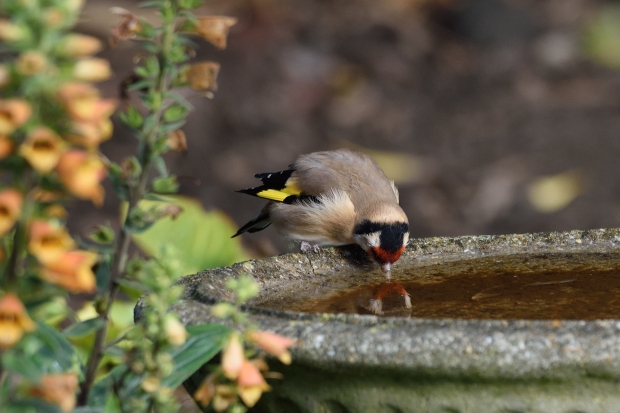
Goldfich taking a drink

Earlier this year I bought myself a New Testament in the original Koine Greek language. I was surprised by the order of the books. In my English Bible Paul’s letters follow on from the Gospels and Acts. In the Greek, the catholic or general epistles precede Paul’s. Thus the first letter is James’.

What is the first thing that James says to his readers? “Consider it pure joy, my brothers and sisters, whenever you face trials of many kinds, because you know that the testing of your faith produces perserverance. Let perseverance finish its work so that you may be mature and complete, not lacking in anything.”

I have a bird bath in my garden and have been waiting for weeks to capture a photo of a bird actually using it. This week the waiting finally paid off. First a goldfinch came a drank right in front of me, then, the following day, a green finch did the same thing. On both occassions I was only a few feet away with my camera in hand. My patience and perserverance finally was rewarded with some great close-up shots.

Please excuse my mundane and simple anecdote, to illustrate such profound, biblical and pastoral teaching. I was thrilled to get these photos. I wonder whether James had this feeling in mind when he urged his readers to ‘consider it pure joy’.

Winter lockdown

Goldfinch in winter lockdown

This last weekend the RSPB ran its annual survey of garden birds. By all accounts the number of people submitting data increased significantly over last year and their were reports of people being unable to access the survey web page to record their count. Quite probably this was the ‘lockdown effect’.

My own count included 8 goldfinches. They are small birds, quite striking in appearance with their red face and yellow finch stripes on the wings. They normally form groups in the winter which may contain other finches, e.g. greenfinch, siskin, chaffinch. These groups are referred to as ‘charms’.

The UK winter lockdown continues. Yesterday we lost Captain Sir Tom Moore, a covid hero who raised over £38m last year on his 100th birthday for the NHS. The vaccine rollout continues offering light at the end of the tunnel, even as the virus continues to take its toll. This latest winter lockdown does appear to be accompanied by fatigue and weariness.

Blackcap

Blackcap (male)

The blackcap is a winter visitor from possibly Germany or north-east Europe. This chap arrived just before Christmas and hung around for a few days. We were having lunch in the dining room when he appeared in the bush at the end of the garden bathed in sunlight. I could not resist grabbing the camera for a few shots before he flew off.

Is this a chickadee?

Blue tit enjoying sunshine after Storm Christoph

“It rained and it rained and it rained. Piglet told himself that never in all his life, and he was goodness knows how old – three was it, or four? – never had he seen so much rain.”

Winnie-The-Pooh, A.A.Milne, Chapter 9 …in which Piglet is entirely surrounded by water

Storm Christoph wasn’t too bad for us personally, although there were heartbreaking pictures on the news of its impact in other parts of the country.

But today the rain stopped and the sun came out. The birds returned to the feeders.

The Blue tits visited and sang whilst performing their acrobatics. I think I prefer US name Chickadee to the UK Tit, even though it probably would only apply to our Willow tit or Marsh tit. It’s so much more genteel.

Anyway, here is a Blue tit in our garden enjoying the sun.

Refilled feeders

Blue tit

Today I heard the birds singing in the garden. Probably happy that I had refilled the feeders. The Robin was the most vocal.

Hark! The herald angels sing,
“Glory to the newborn King!
Peace on earth and mercy mild,
God and sinners reconciled.”
Joyful, all ye nations rise,
Join the triumph of the skies,
With th’angelic host proclaim:
“Christ is born in Bethlehem.”
Hark! The herald angels sing,
“Glory to the newborn King!”

Christ by highest heav’n adored,
Christ the everlasting Lord!
Late in time behold Him come,
Offspring of a Virgin’s womb.
Veiled in flesh the Godhead see,
Hail the incarnate Deity,
Pleased as man with man to dwell,
Jesus, our Emmanuel.
Hark! The herald angels sing,
“Glory to the newborn King!”

Hail the heav’n-born Prince of Peace!
Hail the Son of Righteousness!
Light and life to all He brings,
Ris’n with healing in His wings.
Mild He lays His glory by,
Born that man no more may die,
Born to raise the sons of earth,
Born to give them second birth.
Hark! The herald angels sing,
“Glory to the newborn King!”

Lyrics by Charles Wesley

I wish you a Merry Christmas and a Happy New Year!

Long tailed tit
Robin in song

Mistle Thrush

Mistle Thrush

Yesterday we had two Mistle Thrush turn up in the garden. They tend to show up at this time of year. My observations aren’t exactly scientific, but I do have a couple of similar photographs from early in December 2019. It might be that they’re just a bit more obvious at this time of year due to the lack of foliage on the trees, but I suspect that that they are looking for food in local gardens as the food supplies in the nearby woodland becomes more scarce.

They are a bit bigger than our usual resident species of sparrows, robins, and finches. Probably just a bit bigger than a blackbird. The large spots on its light coloured chest are a significant element of its identification. The photo was taken through a grubby kitchen window so the picture isn’t of the highest quality. I always enjoy seeing these birds and trying to figure out whether they are Song Thrush or Mistle Thrush.

Another subtle observation and reminder of the natural rhythm and season.

Hornet and changing seasons

European Hornet

This hornet provided an opportunity to practice some macro photography with my boys. He was a bit dozy and slow so quite a good sitter. The image is actually from late September when the season was changing from summer to autumn.

Tomorrow I’ll move on to images of the changing season as we move from autumn to winter. Most of the leaves have fallen from deciduous trees and what is left is brown and orange.

Due to lockdown many more people are taking an interest in the natural world. Last weekend I visited our local reservoir, Longham lakes. We were joined by walkers, photographers and fishermen. This fisherman was particularly proud of his afternoon catch and attracted the interest of quite a few people – all maintaining the appropriate social distance. After the photo op the carp was returned to the lake.

Fisherman with recently caught Carp

The Sparrowhawk

Female Sparrowhawk

Wildlife photo opportunities last only a few seconds. This female sparrowhawk landed in my back garden this morning. This was the first time observed visit in the last fifteen years. It stayed for only 20-30 seconds, then it was gone. The poor quality of the photo reflects: the low light conditions (requiring a high ISO setting and a low shutter speed), shooting through a dirty patio window, and the limited time available to adjust the manual focus.

There are over 35,000 pairs in the UK. It is an extremely swift bird of prey, taking its quarry by surprise. It will attack most bird species up to the size of a wood pigeon.

The Woodpigeon

Woodpigeon

Easily overlooked, this is one of the UK’s most numerous birds. There are over 5 million pairs. Not to be confused with the slightly smaller Feral Pigeon seen in city centres.

The woodpigeon is predominantly blue-grey. It has a white patch on its neck, a white crescent on the wing and a dark grey/black band on its tail.

The Magpie

Magpie

The collective noun for a group of Magpies is: a mischief of Magpies. Allegedly, the Magpie can recognise itself in a mirror. It has a reputation as a thief both in culture, e.g. The Thieving Magpie (Rossini), and with gamekeepers for taking eggs. Sightings of the bird are linked to superstition: “One for sorrow, two for joy…”. I have known people who actually have an antidote phrase they speak out whenever they see a group of Magpies.

Magpie in flight
Magpie

The bare facts: There are 600,000 pairs in the UK and the population is growing as they adapt to more urban settings. The oldest ringed bird lived for more than 21 years. The bird appears as black and white, but when seen close up there is an iridescent blue/green sheen to the wings and tail. They will eat anything.